What's new

"America Party" - 3rd Party Announced

  • Context: Other 
  • Thread starter Thread starter Grinkle
  • Start date Start date
Click For Summary
SUMMARY

The forum discussion centers on Elon Musk's announcement of the "New Super Duper America Party" (NSDAP) and its potential impact on the U.S. political landscape. Participants express skepticism about Musk's commitment and the party's viability, noting historical challenges faced by third parties, such as ballot access and voter hesitation. The conversation highlights the possibility of a third party influencing congressional dynamics by targeting specific swing districts rather than pursuing a presidential campaign. Overall, there is a cautious optimism that a successful third party could disrupt the current two-party system.

PREREQUISITES
  • Understanding of U.S. political party dynamics
  • Familiarity with historical third-party movements, such as Ross Perot's campaign
  • Knowledge of congressional election processes and swing districts
  • Awareness of ballot access laws and their implications for third parties
NEXT STEPS
  • Research the historical impact of third parties on U.S. elections
  • Investigate ballot access requirements for third-party candidates in various states
  • Explore strategies for campaigning in swing districts
  • Analyze the role of financial backing in political campaigns, particularly for third parties
USEFUL FOR

Political analysts, campaign strategists, and individuals interested in the evolution of U.S. political parties and electoral strategies.

Grinkle

Moderator
Diamond Member
Messages
517
Reaction score
292
Not sure what to make of this event other than to find it interesting.

Musk has a ton of money and a non-trivial base of followers, so if he's serious about making an impact, he can make an impact.

On the other hand, he's much more about public statements than follow-through, so maybe this all just going to fade away; a curious odor that is gone before one can figure out where it came from.

I hope it persists and develops into something meaningful. Our two party system is dysfunctional, and a third party that gathers even a few house seats would be a group that could demand to be negotiated with given the margins recent house majorities have held. I am doubtful that Musk's idea of fiscal and social responsibility aligns with my own view, but that aside, I'd welcome a 3rd party that could actually elect a few folks to the HoR.

 
Musk himself is toxic to most. However, if properly orchestrated and if Musk keeps a low profile, maybe it could work. He could save a few republican butts.
 
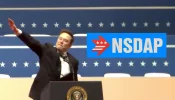
I don't know how seriously this actually is. But a German satire website has already a comment:

Musk-Partei.webp


Washington (dpo) - Now Elon Musk is making a decision: After his announcement that he wants to found a new party, the US billionaire today officially presented the "New Super Duper America Party" (NSDAP).

 
How do you see this scenario?
There are republicans who dissapprove of Trump's agenda but do not have the guts to buck him for fear of facing a primary without Trump's support. With some good financial backing, they might gain enough moderate repubiclan and independent votes to beat Trump's nominee.
 
Within my lifetime several 'third parties' arose, usually to manipulate a specific election, only to disperse else amalgamate with a party that actually wins elections. Texan Ross Perot fit the billionaire tech titan model while George Wallace created a white supremacist political party not long after the Democratic Party converted from virulent racists to a more inclusive model.

Odd how the current Republican party absorbed Tea party, American fascists and most Libertarians. Curious also how John Anderson, ostensibly an Inpendent, without winning a state nor an electoral vote, attracted over 5.5 million votes that may otherwise have helped incumbent Jimmy Carter defeat actor/demagogue Ronald Reagan.

The recent history of third political parties provides little reassurance for preserving democracy.
 
@Klystron I hope any newly formed serious 3rd party wouldn't bother with a presidential candidate. Just electing a handful of congresspeople seems a much more pragmatic target.

If it happened that neither party could appoint a speaker without the support of the 3rd party, that would really change the way congress operates. I hope it would make congress more centrist and more productive, but it could also go in the other direction.

Regrettably, the only prediction I have conviction on is that the current 2 party polarization is a very stable equilibrium, and won't be reversed without adding another degree of freedom (adding a 3rd party, I mean).
 
The viability of a third party can be assessed by looking a the Perot presidential campaign. At one point in July of the election year, he led Bush and Clinton in public polls. He had difficulty following the advice of his campaign advisor and dropped out only to reenter in October. He did garner about 20% of the popular vote drawing almost equally from the democrrats and republicans. He did not win any states but did take several counties in a number of states. Exit polls showed that 35% would have voted for him if they thought he could win. If they had, he would have won.
I think the right candidate in a well run campaign could suck enough votes from MAGA to give the democrats a win.
 
The viability of a third party can be assessed by looking a the Perot presidential campaign.

I think looking at the historical performance of presidential 3rd party candidates is only relevant if a 3rd party intends to run a presidential candidate. Here is a little more meat on the bones of my statement in post 8 that this is not the most pragmatic approach.

3rd party presidential candidates struggle for three main reasons -

1. Ballot access
2. Voter hesitation to vote for a candidate they don't believe has any chance of winning
3. Federal matching funds being based on prior election performance (which 3rd parties don't have)

Posit that a 3rd party picks 6 congressional races that they seriously want to win in swing districts - what state doesn't matter, just picking the ones where a 3rd party candidate might win matters.

1. Ballot access is only a problem in at most 6 states, not 50 states - much more tractable.
2. It seems to me (fwiw) that voters in a single congressional district need to take less of a leap of faith that a 3rd party candidate might win than voters voting for president.
3. Money can be a non-issue if we are talking about Musk needing to fund 6 congressional races - he can afford that.

The message can be -

"We are the gate to the speakership. We will insist on x/y/z or we will not allow a speaker to be selected and the House cannot conduct any business. Be a part of this historical disruption."

Now, perhaps D's and R's would band together to elect a speaker without the 6 votes - even that would be a huge positive step since they would need to co-operate somewhat and power-share.

Perhaps the margin wouldn't be close enough for 6 votes to be a block to selecting a speaker - then the whole thing would be a dud.

But it seems so much more possible to me than having a viable 3rd party presidential candidate, or even a viable spoiler candidate.

Edit: I don't like Musk and I don't wish him any political success. I'd have posted the same arguments about any potential 3rd party formation.
 

Liberal Democracy Values

  • Free and Fair Elections
  • Rule of Law
  • Separation of Powers & Checks and Balances
  • Protection of Civil Liberties and Human Rights
  • Pluralism & Political Competition
  • Independent Media & Free Press
  • Open Civil Society

Community Values

  • Civility
  • Productivity
  • Good Faith Debate
  • Evidence Based Debate
  • Transparency
  • Integrity

Community Motto

"It is the responsibility of intellectuals to speak the truth and expose lies." - Noam Chomsky
Back
Top