What's new

Causes and remedies around post-pandemic inflation

Click For Summary
SUMMARY

The forum discussion centers on the causes of post-pandemic inflation, attributing it primarily to supply chain disruptions and the significant increase in the M2 money supply due to government fiscal relief measures. The M2 money supply saw a sharp increase starting February 2020, which correlated with rising inflation levels in the US and globally. Participants argue that while supply chain issues were a major factor, the monetary policy response, including Federal Reserve rate hikes, had minimal impact on curbing inflation, as evidenced by sustained consumer spending and corporate investment.

PREREQUISITES
  • Understanding of M2 money supply and its implications on inflation
  • Familiarity with fiscal policy and government relief programs
  • Knowledge of supply chain economics and its global impact
  • Awareness of monetary policy tools, particularly interest rate adjustments
NEXT STEPS
  • Research the relationship between M2 money supply and inflation trends
  • Examine case studies on global supply chain disruptions post-COVID-19
  • Analyze the effects of Federal Reserve interest rate hikes on consumer behavior
  • Explore fiscal policy responses to economic crises in different countries
USEFUL FOR

Economists, policymakers, financial analysts, and anyone interested in understanding the dynamics of inflation in the post-pandemic economy.

Messages
114
Reaction score
98
I believe post-pandemic inflation was a global phenomena caused primarily by supply chain interruptions and secondarily by many governments providing fiscal relief to their populations.
I think the supply-chain problems alone would have caused a temporary spike in prices, which would return to normal as production resumed. In the US, the overall increase in price level was caused by the sharp increase in money supply during the pandemic, which is how the federal government paid for all the relief programs.

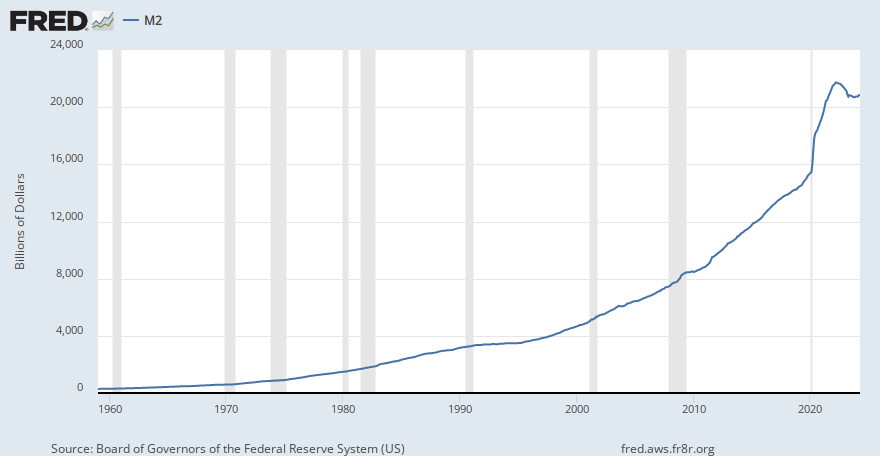
If you look at the M2 money supply for instance, it grew at a fairly constant rate until Feb 2020, when there was a sharp jump, and afterward grew at a faster rate than it did in the pre-pandemic years until it peaked in 2022. When all that money is pumped into the economy, inflation is almost sure to follow. The subsequent downturn in M2 was the Fed trying to slow the economy down without tipping it into a recession.

I assume other countries financed their relief efforts the same way, so it's not surprising they also experienced rising prices as their economies reached full employment.
 
I'm putting the thread in the international forum because I view post-pandemic inflation as a global phenomena. @placebo responded to a comment I made on inflation in another thread and that response inspired this thread, his response is copied below as it frames the discussion quite well.
 
For me, at least, if I were to become convinced that US monetary policy was, say 90% responsible for inflation, it wouldn't change my own perspective on whether the response was appropriate. I believe it was appropriate and in any case COVID relief was supported by both administrations 45 (3.6T) and 46 (2.1T). When Biden announced American Rescue, I was very concerned that if the US did tip into a recession it would be a lengthy recovery and I believed the additional 2T from 46 was good policy. Now I wonder, with hindsight, if the US really needed that, but I'm not sure how to come up with a what-if to argue that we'd have been fine anyway. All that to say for me, arguing 'its mostly supply chain' is neither supporting Biden or decrying him - its just a discussion about economics.


Two things lead me to believe that the inflation was primarily supply chain driven.

1. When the Fed raised rates, the US economy never did tip into recession. Moreover, consumer spending didn't drop much.

Good lord. I am going to de-rail my own thread. Went here to find a graph and look what I got instead. &^%$*#

1743333237822.webp

Inflation eased without much demand destruction.

2. The inflation curve shape looks very similar country-to-country and while it wouldn't surprise me that all countries had similar monetary policies, to me its more plausible that the direct COVID impacts to supply was the most similar thing happening to all countries. To my eye, there is a global inflation peak mid-2023 followed by a global decline. I think supply chain recovery is a good explanation for this. I suspect Fed rate hikes have had very little impact on inflation except to calm markets that the appropriate actions were being taken, but I'm not sure how to argue that counter-factual either (if the Fed had done nothing inflation would still be more or less where it is today).

 
Went here to find a graph

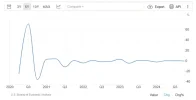
Ok, this graph shows % change QoQ in US consumer spending, and I believe supports my argument that whatever Fed rate hikes did, demand destruction was not one of the effects. The data values in the graph are actually %'s, so the Chg % (which I did NOT select) is a delta % of the % change, or the 3rd derivative of consumer spending, I think. Its a bit convoluted since the "Value" is itself a % change. I think Value is 1st derivative of spend, what I chose is 2nd derivative, the change in the reported % change. yeeesh.

1743339692113.webp
 
this paper by Luca Forno and Martin Wolf
Thanks for linking this. I gave it a quick read, I'll need to spend more time to be sure I am getting the arguments. My initial reaction is that what this paper describes is not what happened in the US, at least.

Anecdotal recollections on my part - if anyone wants references, I will find them or I will correct my statements.

Employment here remained strong, much to the continuing surprise of most folks on Bloomberg TV. Corporate investment remained strong, in part driven by AI mania. The Fed did not need to lower interest rates to make this happen, in fact, they raised rates with (as far as I can tell) little effect on anything, although I can't know how high inflation might have gotten had they not raised rates.

I definitely agree that the supply shock was not short lived, as the authors are positing. Very interesting and digestible paper, thanks again.
 
I agree with you on the things that you have described. But I have a bit of a different interpretation about some of the structural effects on unemployment and investment.

The first version of the paper was published on March 3, 2020. This is before any significant government action had been taken. The NBA didn't cancel the 2020 season until March 11.

It seems to me that of the possible policy recommendations described in the paper (which I take to be the idea that fiscal policy intervention would be insufficient and a proper response would require monetary policy interventions to avoid the worst structural outcomes for the economy) is one of the strengths of the paper, since that is what most major governments ultimately decided on. They conclude by saying:
If this possibility materializes, this simple model suggests that drastic policy interventions- both monetary and fiscal- might be needed to prevent this negative supply shock from severely affecting employment and productivity.

So, the fact that unemployment and corporate investment remained strong could be attributed to the intervention that they recommended, which was, in fact implemented.

But the real meat of the paper, in its description of the supply and demand Doom loops based on consumer confidence and global panic - the "animal spirits" they describe - seems to have been a very significant mechanism for the harms that we saw to global supply lines and manufacturing during and and after.
 

Liberal Democracy Values

  • Free and Fair Elections
  • Rule of Law
  • Separation of Powers & Checks and Balances
  • Protection of Civil Liberties and Human Rights
  • Pluralism & Political Competition
  • Independent Media & Free Press
  • Open Civil Society

Community Values

  • Civility
  • Productivity
  • Good Faith Debate
  • Evidence Based Debate
  • Transparency
  • Integrity

Community Motto

"It is the responsibility of intellectuals to speak the truth and expose lies." - Noam Chomsky
Back
Top