What's new

Charlie Kirk Assassination

Click For Summary
SUMMARY

The forum discussion centers on the assassination of Charlie Kirk, highlighting the complex emotions surrounding his death due to his controversial ideology and activism. Participants express a mix of indifference and condemnation, emphasizing that while no one deserves to be murdered, Kirk's rhetoric contributed to a culture of violence. The conversation critiques the disparity in media attention between Kirk's assassination and other instances of gun violence, questioning societal values regarding free speech and the normalization of political violence. The discussion ultimately reflects on the implications of Kirk's death for political discourse and the broader societal context of violence in America.

PREREQUISITES
  • Understanding of political discourse and its impact on society
  • Familiarity with the concepts of free speech and its limitations
  • Knowledge of recent political violence and its historical context in the U.S.
  • Awareness of gun violence statistics and their societal implications
NEXT STEPS
  • Research the implications of free speech in political contexts
  • Examine the history of political violence in the United States
  • Analyze media coverage disparities in violent incidents
  • Study the psychological effects of political rhetoric on public behavior
USEFUL FOR

This discussion is beneficial for political analysts, sociologists, journalists, and anyone interested in the intersections of ideology, violence, and media representation in contemporary society.


Trump should deploy federal troops to Utah. Clearly they have a crime problem.
 
You might if you met them. You might not, too, but its much harder to stay cold-hearted when f2f with people.
There's a vast gulf between "don't murder him" and "feel bad because someone murdered him."

I haven't murdered him and I wouldn't.

I'll never care about him or his kids or his wife.
For some reason people feel an attachment with 'their' celebrities, sometimes to the point of infatuation, but mostly it's as if one knows the individual as a friend/enemy. ( be it either in a good way or a bad way ).
So they weep, or celebrate, if harm falls to their celebrity that they have projected as having their same, or opposing values.
They might rage if the harm is the result of violence, and throw blame around for a situation that, to them, is seemingly not understandable, call the perpetrator a monster, and associate him/her with a group of dislike.

Being agnostic to Kirk's fate is just that. Agnostic towards someone not known personally.
For someone in their sphere of influence, the emotion may show.
Neither are defects in someone's character.

The problem here, with Kirk's death, is the political gain being attempted by certain members of Maga, that it is a defect, especially directed at those they call the left.
It is these types of Maga folk, not all of them, that are the coldhearted ones, using someone's death, to further their viewpoint onto others ( moment of silence, medal ?? ).

Kirk's death was tragic. Yes, it was. Somehow he punched above his paygrade in his (in)ability to debate. His most endearing quality, though, was bringing discussion to the everyday campus and younger people, to get them to think somewhat independently, albeit from a 'right wing' slant.
I mourn his death for that reason.
 
And Canada. Somehow that has spilt over into the rightist influencers agenda, as if Kirk's rhetoric was somehow representative of Canadian values ( whatever that may be ) . It really devalued my opinion of their minds.

I just read a very disgusting quote from Kirk (about the death penalty and that executions should be public). I don't feel like checking its authenticity because I don't want to deal with such disgusting things. But if I judge this man by what he said, then I really can't mourn his passing.

I think that such movements come in waves and affect all countries. I can only hope that they remain the minority. At least I'm quite certain that we would never elect (again!) such a moron into office. I live in a city with about 50% non-German citizens (285 of whom are US-American), and it works quite well. The last thing we need are Nazis of any kind.


 
Last edited:
I just read a very disgusting quote from Kirk (about the death penalty and that executions should be public). I don't feel like checking its authenticity because I don't want to deal with such disgusting things. But if I judge this man by what he said, then I really can't mourn his passing.

I think that such movements come in waves and affect all countries. I can only hope that they remain the minority. At least I'm quite certain that we would never elect (again!) such a moron into office. I live in a city with about 50% non-German citizens (285 of whom are US-American), and it works quite well. The last thing we need are Nazis of any kind.


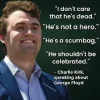
So I checked the authenticity.

For the public execution comment, it is true, the video of his show can be found on Reddit:


For the Floyd comments, I could only find the "He's a scumbag" comment at 8:25 on this podcast:


But - about the Floyd comments presented - I think this Instagram reel is the source, and the whole comment is a lot heavier against conservative hypocrisy and will resonate with @fresh_42 's question that no one can really answer:

 
Kirk's "principled" free speech stance was purely partisan theater. He'd rage about censorship when conservatives got deplatformed, then cheer when the same mechanisms targeted leftists. His opposition to state authority was conditional. Anything was justified when wielded by Trump, tyrannical when wielded by anyone else.

The real irony isn't that a "free speech champion" is being used to justify censorship. It's that a partisan hack who only cared about free speech for his team is now the excuse for his team's direct government censorship. Kirk would absolutely support Carr's threats against Kimmel. He'd probably be writing op-eds about how comedy shows spreading "disinformation" deserve regulatory scrutiny.

Kirk spent years arguing that private companies had every right to silence speech they disliked, but government should step in when those same companies silenced conservative speech. Now his death is the pretext for government stepping in to silence liberal speech through regulatory intimidation.

The consistency is perfect: Kirk's political philosophy was always "free speech for me, consequences for thee." His posthumous legacy is exactly what he would have wanted; government power deployed against his enemies under the banner of protecting truth and public interest.

EDIT:

And the fucking Canadian government gave this dipshit a standing ovation:


I guess it fits, given the last standing ovation I can remember was one of the old-school Nazis:

 
And the fucking Canadian government gave this dipshit a standing ovation:
Private member Conservative MP Rachael Thomas eulogy in Parliament. not government, for a controversial figure.
I imagine she was disappointed that no one from the Liberal government side ejected boos, thus not invoking a scandal she obviously expected as the Conservative opposition that would annoy Trump, which Carney would be in a tight spot to explain.
Such a low key shallow insignificant individual, as. shown by her stunt of using someone's death for attempted political gain. Easily outsmarted by the Liberals.
Way to go Rachael Thomas to lower the respect people have of their politicians.

See post 64
And Canada. Somehow that has spilt over into the rightist influencers agenda, as if Kirk's rhetoric was somehow representative of Canadian values ( whatever that may be ) . It really devalued my opinion of their minds.
 
Last edited:
Every US Senator just voted in favour of a national day of remembrance for Charlie Kirk.

The Democrats just unanimously endorsed martyrdom status for someone who built his career calling them communist pedophile groomers.

This is complete capitulation of oppositional capacity. They're actively participating in their own delegitimization. Every Democrat who voted for this resolution just validated the premise that Kirk represented honorable civic discourse worth commemorating, despite his systematic dehumanization of their voters.
 
Every US Senator just voted in favour of a national day of remembrance for Charlie Kirk.

I have occasionally been called anti-American for my criticism. Truth is, I am pro-American because of the ideals the USA claims to have. My problem is that I measure them against those ideals, and my criticism evolves from disappointment. This goes as far as I consider Americans to be the world champions of hypocrisy: pro-life vs. pro-guns, pro-religious freedom vs. advertising only one of those in schools, pro-free speech vs. censorship in almost every private sector (Kaepernick, Kimmel), pro-equality of people vs. more or less well hidden racism, pro democracy vs. the electoral college, prudery vs. the largest porn industry.

And now they collectively honor a racist who considered murdered children as a necessary and inevitable evil? It becomes harder to feel admiration every day. American politicians have never been further removed from what they claim to be American values.


1758285923096.webp
 
Last edited:
Truth is, I am pro-American because of the ideals the USA claims to have. My problem is that I measure them against those ideals, and my criticism evolves from disappointment.


I too am greatly disappointed but also fearful of the future for my children and grandchildren. The US did not start out exactly the way we perceive its ideals today. The US was never meant to be a true democracy. Power was always meant to be controlled by those who had the knowledge and experience of governance. For most of the time by older conservative, white, Christian men. It was only by 1913 and the seventeenth amendment that people could vote directly for senators, giving them a lot more influence over the country's policies.

Was the founding fathers' fear of the control of the government by the wishes of the general population justified?
 
Was the founding fathers' fear of the control of the government by the wishes of the general population justified?

Well, yes, I think so. We had to cope with it in our own history. Germany had one of the most liberal constitutions ever between 1918 and 1933. As a consequence, it allowed even its foes to advertise their opinions, incite the population with hatred (against the Jews, and everyone on the left, Antifa, sic!), and enabled the election of basically every party, no matter how small. The consequences are known.

However, I like how our founding fathers attempted to solve this problem after WWII. Parties nowadays need at least 5% of voters to send representatives to the parliament (except for the Danish minority at the regional level). Of course, individual persons can be elected directly. Hate speech is prohibited; I call this the Goebbels paragraph. Using the army in any mission requires a mandate from the parliament, changes to the constitution require a 2/3 vote in parliament, and administration is sworn in under what we call the Liberal Democratic Basic Order. Those opposing it are usually under the observation of the secret service. These are the barriers they established to avoid the free, democratic system abolishing itself, as it had happened in 1933. It does not make it impossible, only harder.

These laws do not mean that we don't have free speech. The courts are very picky when it comes to restricting it. The holocaust denial, spreading lies, and basically behaving like Goebbels are forbidden. But that only restricts nutcases. People who know both countries normally admit that they feel even freer in Germany than in the US.

So yes, the fear was justified, but their solution wasn't optimal from my point of view.

 
Last edited:

Stephen Miller, the White House deputy chief of staff, said left-wing organizations amounted to a “vast domestic terror movement.”

“With God as my witness, we are going to use every resource we have at the Department of Justice, Homeland Security and throughout this government to identify, disrupt, dismantle and destroy these networks and make America safe again for the American people,” Miller said recently. “It will happen, and we will do it in Charlie’s name.”

I prefer reading modern US policy announcements in their original German.
 
Last edited:
I too am greatly disappointed but also fearful of the future for my children and grandchildren. The US did not start out exactly the way we perceive its ideals today. The US was never meant to be a true democracy. Power was always meant to be controlled by those who had the knowledge and experience of governance. For most of the time by older conservative, white, Christian men. It was only by 1913 and the seventeenth amendment that people could vote directly for senators, giving them a lot more influence over the country's policies.

Was the founding fathers' fear of the control of the government by the wishes of the general population justified?
A brief history of western civilization, expressed in the US of A.
A mere 6% of 'elite' land owners ruled the land, quite much on par with most western countries of the day.

As someone once said 'give me liberty or give me death'; not 'give me democracy'.
The two are conflated as being necessary for one another.
Most of history was led by those on the side of liberty.

Since we are products of the expansion of liberalism, from the 60's to now through democratic forces, and special interest groups. a change of course to some degree would elicit apprehension.

Is the totalitarianism of the 'left' all that much better than the totalitarianism of the right.?
 
Is the totalitarianism of the 'left' all that much better than the totalitarianism of the right.?
I think that our founding fathers did not believe this. They believed that the government should be run by honorable and rational men. Every election for 250 year we hold our breath to see that they prevail.

The first attempt at a US government was the Articles of Confederation. Its goal was a weak centeral government. Although it lasted about 10 years it showed the need for a stronger government if you wanted a functioning and stable nation. The founding fathers knew that a true democracy was not desireable hoping that a governmental triad deter excesses in governance. The ratifcation of the Consitution showed the necessity and difficulty of determining a common vision for the nation something that we struggle with today.
 
I think that our founding fathers did not believe this. They believed that the government should be run by honorable and rational men. Every election for 250 year we hold our breath to see that they prevail.

The first attempt at a US government was the Articles of Confederation. Its goal was a weak centeral government. Although it lasted about 10 years it showed the need for a stronger government if you wanted a functioning and stable nation. The founding fathers knew that a true democracy was not desireable hoping that a governmental triad deter excesses in governance. The ratifcation of the Consitution showed the necessity and difficulty of determining a common vision for the nation something that we struggle with today.
The US, and Canada, are federations of states, with selected powers divided between the federal and state governments as to who is responsible for what. As a general rule, in both countries the division of power is quite much the same, with of course some overlap, with friction between the two as to who has the actual jurisdiction. For Canada, this was laid out in the British North America Act of 1867. Pretty much anything regarding two or more provinces, such as navigation, money, defense,, criminal law .. would be a federal responsibility. Anything other such as education, health, civil rights and property, resources, ... would be of provincial jurisdiction., based on English Common Law and French Civil law (Quebec).

Before the Act of 1982, Canada did not have a Bill of Rights. which lays out the rights and freedoms of the people of the country. ( elder Trudeau - Bill of Rights Diefenbaker 1962 but legally non-bindimg )such as the US Constitution did from the get go. Peoples Rights were pretty much on the 'Do not be an Asshole' and everyone got along fine so it seems, they say.

An expose of the Bill of Rights, with perceived problems to government restraints, amongst others and benefits. Applicable to the IUS, even if in hindsight.

For both countries, a setting out of a Bill of Rights means that the courts can become interpretive more so in matters relating to the government and its citizens. The courts, using this interpretive measure has the means to alter the direction a legislative body such as state, provincial, federal, municipal., or any other other government body if the law infringes upon the rights and freedoms of the individual.

The US Constitution 'Right to Bear Arms' is an example of why it is so difficult to curtail the proliferation of guns in the US, even if the founding fathers never envisioned the fire power of future weapons. The courts have interpreted this to mean fire arms of the present day, rather than the musket single shot of yesterday, in ,my opinion, legal experts can agree or not.

With no Bill of Rights, things would be simpler upon the legislative bodies regarding civil rights.

What one is seeing in the US of A right now with Trump, is the executive branch attempting to impose their interpretation of civil rights in contrast to the progressives having all on their own to shape society as only they themselves see fit.. The sour response from the progressives stems surely from that of limits being placed upon them ( is cancelling of DEI for example ). The courts are still attempting to interpret laws as they think is the correct interpretation.. Who wins that fight - executive or the courts is still up in the air it would seem.

What happens after Trump is up in the air - not discussed, perhaps tpo early for that yet.

Some progressive decisions that went haywire in Canada.
Quasi Judicial Court Ontario Human Rights commission - a small town(1200 people) and mayor were each fined in breach of the law to not fly the Pride Flag,, and thus infringed upon the applicants human rights. Notwithstanding the fact that the small town did not have a flagpole upon which to place the flag, so I heard.
his may be the second case as there were 2 similar in aspect.

Superior Court, Ontario - court rules bike lanes are a constitutional human right. Removal would violate the Canadian Constitution.

Whether these are haywire, or not, is again interpretive.
A different perspective would be handicap parking, or handicap[ access which mostly is now accepted as being reasonable.

PS - as for being fearful for the next generation(s), I have said so for the last 15 years that their future is not going to be kind. It would be the digital impositions coming about. Like China, like the west, only several decades behind. Take a look at the digital ID being imposed upon Britain - no digital ID, no job, bo health access, no education access, ...
 
Jon Meachum, noted American historian, was interviewed a week or two ago. He made the statement that The US will not resolve its current turmoil until we begin to respect one another.

But here’s the problem. The left, progressive or the Democratic party see much of America’s problem due to lack of respect for many or their problems.

The right finds fault with those who have not achieved their level of self sufficiency and de facto does not respect them and even disdains them.

Race relations is very important to working out differences but, I believe what former Chief Justice Taney said in his decision in the Dred Scott case is still in part prevalent today ‘

“They had for more than a century before been regarded as beings of an inferior order, and altogether unfit to associate with the white race, either in social or political relations; and so far inferior, that they had no rights which the white man was bound to respect; and that the negro might justly and lawfully be reduced to slavery for his benefit.”
Roger B. Taney, Chief Justice, Supreme Court, March 1857

This was reflected in Kirk’s remark:

"If I see a Black pilot, I’m going to be like, 'Boy, I hope he's qualified.'"

And as far as violence is concerned Kirk, sacrifices on the altar of the second amendment are necessary and public executions should be a family outing.

I see a difficulty in respecting those who advocate such things.
 
I see a difficulty in respecting those who advocate such things.
My problem with Charlie Kirk is not that I have difficulty respecting him; it is just that I don't know how.

He said that a few deaths here and there are OK as long as the rights of gun owners are protected. how can I make a big thing of his death?

He also said empathy is a made-up word that does a lot of damage, how can I have some for him or his family?

So, to honor him, is it better to react the way he would if it happened to someone else or to react like a loving and caring human being?
 
So, to honor him, is it better to react the way he would if it happened to someone else or to react like a loving and caring human being?
Honoring should require a recognition of merit or admiration. Not honoring does not imply denigration.

One will mourn a victim if one has a relationship of some kind.

One may also express sorrow for an event.

What many seem to want is empathy for Kirk's shooting, a term he said: “I can't stand empathy. I think empathy is a made-up, New Age term that — it does a lot of damage, but it is very effective when it comes to politics.”


Liberal Democracy Values

  • Free and Fair Elections
  • Rule of Law
  • Separation of Powers & Checks and Balances
  • Protection of Civil Liberties and Human Rights
  • Pluralism & Political Competition
  • Independent Media & Free Press
  • Open Civil Society

Community Values

  • Civility
  • Productivity
  • Good Faith Debate
  • Evidence Based Debate
  • Transparency
  • Integrity

Community Motto

"It is the responsibility of intellectuals to speak the truth and expose lies." - Noam Chomsky
Back
Top