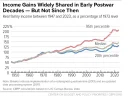
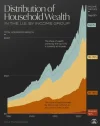
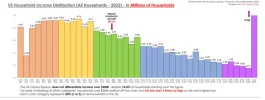
An interesting snip from the Pew Research link above. There are at least two narratives for this, I don't know if either is accurate or if they can both be partially true.
1. Income inequality is even worse than the government reports, a lot worse (.6 vs .42).
2. The US already has very impactful policies in place to alleviate income inequality, and they are working as evidenced by what the number would be without these policies.
======
The
Congressional Budget Office (CBO) offers an alternative estimate of income inequality that accounts for federal taxes and a more comprehensive array of cash transfers and in-kind services than is possible with Current Population Survey data. The CBO finds that the
Gini coefficient in the U.S. in 2016 ranged from 0.595, before accounting for any forms of taxes and transfers, to 0.423, after a full accounting of taxes and transfers.
======
I believe (I can be argued out of this, I don't have a lot of conviction on this topic, it seems very complicated) that the only way to reduce wealth disparity is through direct wealth re-distribution. I don't think attacking inflation will change the distribution very much.
Examples of wealth re-distribution -
1. Funding need-based public services via property taxation (the only broad wealth tax currently in place in the US)
2. Minimum wage regulation
3. Funding need-based public services via asset taxes other than property taxes (afaik there is none of this in the US right now)
4. A universal income funded by income tax revenues (in the US this would mean increasing upper income tax brackets and probably require asset taxes or consumption taxes in addition, since many wealthy folks can borrow money to fund their lifestyle and not have much income to tax).
I can't think of a set of indirect policies that I believe would accomplish more even wealth distribution in the US - its seems to me that you simply have to directly re-distribute wealth, if that is to be a social goal.
I'd be very interested to find out I am overlooking things - either things done in other countries or things that might be tried and haven't yet.


 www.pewresearch.org