What's new

American gun laws and attitudes towards gun ownership

Click For Summary
SUMMARY

The discussion centers on American gun laws and public attitudes towards gun ownership, highlighting the complexity of regulations across different states. Participants express concerns about the representation of opinions in polls, particularly regarding the National Rifle Association (NRA) and the perceived extremity of gun culture in the U.S. Comparisons are drawn with countries like Australia and Germany, emphasizing the need for nuanced understanding of firearm regulations. The conversation reveals a significant divide in attitudes towards gun ownership, influenced by regional laws and personal experiences.

PREREQUISITES
  • Understanding of the Second Amendment and its implications
  • Familiarity with U.S. federal and state firearm regulations
  • Knowledge of public opinion polling methodologies
  • Awareness of international firearm laws for comparative analysis
NEXT STEPS
  • Research the impact of the NRA on U.S. gun legislation
  • Explore comparative studies of gun laws in Australia, Canada, and Germany
  • Investigate the role of public opinion polls in shaping firearm policy
  • Learn about the legal distinctions between open carry and concealed carry laws in various states
USEFUL FOR

Policy analysts, legal scholars, sociologists, and anyone interested in understanding the dynamics of gun ownership and regulation in the United States.

Messages
1,110
Reaction score
1,515
I think a weekly poll would be great! Do we have any volunteers or ideas for initial poll questions?
There is a question that has been driving me for a while now. What are the actual opinions about US-American gun laws among the population, and how are specific points of view distributed? I can only read about the standard extreme positions here that give me the impression that the USA is a country of irresponsible gun fanatics. I like to call the 2nd as the right to murder each other. However, there are many possible positions in between, as countries like Australia, Canada, and even Germany demonstrate. What do people really think? Is the NRA position as representative as they pretend to be?

I have no information about institutes in the US that deal with countrywide studies about people's opinions, so it's hard for me to even begin an internet search. On the other hand, and that holds for any poll here, I do not expect the outcome to be representative. Assuming this bias, any poll would be more like a betting office where people bet on future events rather than expressing personal opinions. Which of them should it be? Do we bet on a possible impeachment or do we ask whether tariffs are a valid method to protect / create incentives for domestic producers, fight trade deficits, or is it an anachronism in a world of global work benches?
 
@fresh_42

Regarding firearm policy, a question might be -

Are firearm regulations in your district too controlled, too loose, or about right?

I'd be interested in hearing what folks in other countries think about their own firearms regulations. Hopefully such a poll question would spur some interesting discussion.

Here in the US, there are overlapping laws with confusing (to me) hierarchies.

The US constitution
Federal law
State law (and state constitutions)
City / County law
Private property owner stipulations

In the city where I live, and I believe in the entire state (of Texas), if a business owner says "no firearms allowed on these premises" then there are no firearms allowed on the premises, Texas being a state where open carry without requiring a permit is legal per state constitution not-withstanding. Similarly, I believe cities and counties can restrict open-carry if they want to by local ordinance, but I'm not sure about that. I don't think they can restrict concealed carry with a permit, but businesses can. Again, I'm not completely sure, I just know it gets byzantine quickly when considering any scenario outside of ones home, inside which pretty much anything goes based on the Federal constitution. I'm not all saying that there are lots of restrictions outside the home, I'm saying that the specifics and corner cases of what is legal in terms of possessing firearms outside your home have a pretty large variation. I think its relatively less complicated to purchase a firearm than it is to figure out where you can legally be carrying it.

My point is that when one asks an American about gun regulation, the regulation is very different (more strict) in New York than it is in Texas, so the attitudes towards the regulation may also be different.
 
I'd be interested in hearing what folks in other countries think about their own firearms regulations.
But a poll doesn't count who is from where. It only counts, and the US-American view is probably different from any other country. I was interested in the opinions within the US-American society, since from here in Germany it looks as if you are all crazy nuts, accepting more than 30,000 casualties per year, for basically nothing in exchange.

I regularly think that I am the only one who hasn't forgotten Sandy Hook.
 
There is a question that has been driving me for a while now. What are the actual opinions about US-American gun laws among the population, and how are specific points of view distributed? I can only read about the standard extreme positions here that give me the impression that the USA is a country of irresponsible gun fanatics. I like to call the 2nd as the right to murder each other. However, there are many possible positions in between, as countries like Australia, Canada, and even Germany demonstrate. What do people really think? Is the NRA position as representative as they pretend to be?

I have no information about institutes in the US that deal with countrywide studies about people's opinions, so it's hard for me to even begin an internet search. On the other hand, and that holds for any poll here, I do not expect the outcome to be representative. Assuming this bias, any poll would be more like a betting office where people bet on future events rather than expressing personal opinions. Which of them should it be? Do we bet on a possible impeachment or do we ask whether tariffs are a valid method to protect / create incentives for domestic producers, fight trade deficits, or is it an anachronism in a world of global work benches?
This is a purely anecdotal account of what I've seen over the years mixed with some of what I've read. I have read that somewhere around 75+% of the guns in the U.S. are owned by around 3% of the population. This matches well with my experience and it's why I think that a poll would be difficult. Most of the people that I know, don't own a gun but the ones who are big second amendment supporters own multiple guns of various kinds - usually 10 or more.

I have four acquaintences who fit the multi-gun profile - two are ex-military and the other two hunt a lot. In this particular group, the two ex-military tend to have the AR15 type weapons and emphasize needing them for protection. The hunters have hunting rifles of course and those are the two idiots who have actually pointed weapons at me - with one pulling the trigger on an empty shotgun.

The farther out into the country that you get, the more gun ownership that you see - when I used to go camping, it was pretty normal for everyone you met to say that they had guns if the topic came up.

I don't have any personal experiences with inner-city gun ownership. From what I've watched over the years on local news channels, the story is generally the same in most cities - drug deals gone wrong and gang turf disputes that escalate. Too much easy access to guns.

There have been efforts of various kinds to figure out what causes gun violence in the U.S. but the NRA uses congress to fight any attempts at understanding the causes. Another case of a small minority that causes misery for everyone else.

I used to own two rifles in my 20's but haven't had any for years. I really didn't like the culture. From the gun owners that I've known over the years, I think the the whole gun culture is mostly a power trip for many - i.e., look at my big powerful penis.
 
@fresh_42

Similar to @Borg, I don't own any guns but I grew up around lots of gun culture. I have the same anecdotal experience of knowing more people who own many guns or zero guns than people who own one gun.

The stated reasons I have heard are protection and hunting.

The unstated reason strikes me as conferring a sense of general personal security to the owner. I know many gun owners, I don't know any who have a story about how their weapon helped them out in any way.

None of that explains at all why the US can't be content with letting citizens own revolvers, breech loading hunting rifles and shotguns.

I feel like I understand the dynamics that keep congress from passing a budget - I have no idea how it works that something so obvious as banning bump stocks can't stay in place. I have heard people try to make sense of it - I can't. I think it has to be deeper than the NRA being a powerful lobby - maybe most Americans are quietly sympathetic to the 'give an inch they will take a mile' argument, even if they won't admit that to pollsters - I'm really not sure.
 
Here in the US, there are overlapping laws with confusing (to me) hierarchies.

The US constitution
So why don't you have gun laws based on weapons available on 12/15/1791? Muzzleloaders would be a good point to start with!

Edit: I do not understand the argument: "Only a good guy with a gun can stop a bad guy with a gun." This implies that someone with a gun can be instantly and on their own decision, prosecutor, judge, and executioner in one person. How is that constitutional?
 
Last edited:
There exists an older and probably smaller group of American gun owners, many of us military veterans, who shoot or use to shoot guns as a sport, a hobby. I never shoot at living creatures nor consider firearms as either defensive weapons or deterrent to crime. A staff or baton provides more defensive tactics in social situations than firearms without unintended consequences of high velocity rounds missing their target.

Outside qualifying early in my USAF career, I do not shoot nor own AR-15 NATO 5.56 rifles. IMPO they are much too loud even wearing ear and eye protection. I dislike sharing a range with amateur AR-15 shooters, especially modified as handguns, due to excessive noise and blast pressure. AR-15 ammunition is expensive and overpowered for recreational target shooting compared to the nearly identical caliber .22 LR. (.22 inches ~ 5.56 mm)

Armalite developed the AR-15 / M-16 during the Vietnam War using common .22 caliber rifle rounds with an oversized cartridge to increase velocity and greatly increase carnage to human targets. The eccentric bullet tends to tumble and fragment. Ask trauma surgeons.

Even in .22LR form, the round produces unpredictable nasty wounds. Adding more propellant was a deliberate strategy to wound and maim -- not necessarily kill -- enemy targets. Gravely wounded troops cause more problems requiring specific medical care and transport.

Eugene Stoner was a brilliant engineer applying modular theory to produce an easily modified lightweight weapon intended for military combat. While not as popular with professional operators and subsistence hunters, civilians grew to love the modular design and standard user interface. One doubts that Stoner intended this machine as a popular cultural symbol. Proficency can be maintained firing .22 ammunition from the same platform at 1/10 the cost.

I live in Nevada under reasonable gun control laws. Owners must be licensed and pass proficency tests in order to carry concealed weapons. I eschewed firearms after returning from the Vietnam War and leaving active duty but responded to a letter from our CO to retain basic proficiency. Since 2016 and proliferation of civilian deaths, I again stopped target shooting. Too many idiots spoiled what was once a safe precision activity.
 
There exists an older and probably smaller group of American gun owners, many of us military veterans, who shoot or use to shoot guns as a sport, a hobby.
Same here, but that doesn't mean we have a potentially armed population. We also have hunters. Both groups need to undergo an exam and a justification process before they are allowed to possess weapons privately. Of course, we have all the problems that come with it, too: guns used to commit crimes, even occasional mass shootings, suicides, police officers who shoot people, etc. However, not even nearly the (per capita) numbers of the USA. Such incidents are the exception, not the rule.
 
Last edited:
@fresh_42 The below is all me free-wheeling, I expect folks who may have actually studied the history of what I am opining on can poke plenty of holes in it.

I'll contend that one cannot make sense of the status quo wrt to firearms in America if one approaches the question as though the current situation were deliberately arrived at. Looking for an answer to the question "How can Americans want this" is as fruitless as asking "How can Americans want the medical care system that they have".

The status quo is a lump of unintended consequences arrived at via historical failure of political will to keep legislation appropriate to advancing technology and changes in American society making firearm ownership much less a practical need for much of the population as the rural / urban shift in population grew.

I think the right question to ask is more along the lines of what Americans ask themselves about delivery of medical care - how on earth can we fix this, and why are we stuck?

I'll take a stab at 'why are we stuck'. I still have no idea about how do we fix this, or even a good articulation of what I think a fix looks like, if implementable.

1. Distrust of government causing fear of being disarmed and leaving the only weapons in the hand of the government that has self-serving bad intentions. (I admit to have some sympathy for this viewpoint at this moment in time, even though I don't own a gun and I don't think owning a gun would make me feel better or safer in that regard).

2. Distrust of government causing fear of ineffectual application of firearm restrictions, only law abiding citizens will actually be disarmed leaving them at the mercy of still armed criminals.

3. A general endemic sense of entitlement among gun enthusiasts to own any weapon in existence based on US history of always allowing just that, with few exceptions. I think no one argues that they should be able to own a tank or a howitzer, but many Americans do argue that they should be able to own fully automatic weapons.

And related to that point ....

4. Effective well-organized tactical lobbying that can stir emotion very quickly with gun rights folks to exert instant pressure on legislators any time even the smallest restrictions are being debated.

Related to my point on trust, I don't know any Americans (I am sure some exist, though, I hope very few) who are upset that they cannot carry a gun on an aircraft. I chalk this up to trust in two things - first is trust that no one has a gun on the aircraft one is boarding, the second is that the pilot and crew have only good intentions and one doesn't need a weapon to protect oneself from the ruling authority of the aircraft (the pilot and crew). If we can get this 'airport' level of trust around our government, perhaps that would break the deadlock?
 
The below is all me free-wheeling, I expect folks who may have actually studied the history of what I am opining on can poke plenty of holes in it.

My answer will be a personal opinion, too, an opinion from outside the USA.

I think the right question to ask is more along the lines of what Americans ask themselves about delivery of medical care - how on earth can we fix this, and why are we stuck?

This is a different topic, albeit an interesting one. I always have to laugh when people try to diminish universal healthcare by calling it socialist or communist. The first law in that direction, and I think, worldwide, was established by Bismarck to conserve the workforce and decrease the risk of revolting workers. Bismarck was a royalist to the bone and anything but definitely neither a socialist nor a communist. Hence, the idea and its implementation came from a very conservative politician.

1. Distrust of government causing fear of being disarmed and leaving the only weapons in the hand of the government that has self-serving bad intentions. (I admit to have some sympathy for this viewpoint at this moment in time, even though I don't own a gun and I don't think owning a gun would make me feel better or safer in that regard).

As if armed militias wouldn't mean even more severe problems than fewer. Who is to decide when to fight? And what for? Such an argument might have been valid ín the 18th century, but not in the 21st.

2. Distrust of government causing fear of ineffectual application of firearm restrictions, only law abiding citizens will actually be disarmed leaving them at the mercy of still armed criminals.

This is a circular argument, in my opinion. We do have armed criminals, but without armed counterparts, they simply do not have to use them. Showing them is sufficient. How many robberies are actually prevented because shopkeepers are armed? Arms cause an automatic escalation and chances are that more is lost than some money. Arms sell the impression of safety, not safety itself.

3. A general endemic sense of entitlement among gun enthusiasts to own any weapon in existence based on US history of always allowing just that, with few exceptions. I think no one argues that they should be able to own a tank or a howitzer, but many Americans do argue that they should be able to own fully automatic weapons.

Well, I respect that decision. It's the US-Americans who have to pay the price, so I'm ok with it. Just stop complaining about mass shootings and mourning the victims of Sandy Hook. Nobody needs an automatic weapon for hunting or sport. The AR-15 wasn't invented in 1791! Personally, I think that children's lives weigh heavily than some people's right to be armed. But that's not on me to decide this for US-Americans. However, that does not mean I have to understand this point of view.

And related to that point ....

4. Effective well-organized tactical lobbying that can stir emotion very quickly with gun rights folks to exert instant pressure on legislators any time even the smallest restrictions are being debated.

Yes, that's funny, too, how people being afraid of governmental interference are ok being manipulated by the NRA.

Related to my point on trust, I don't know any Americans (I am sure some exist, though, I hope very few) who are upset that they cannot carry a gun on an aircraft.

This always comes to mind when I look at the number of Americans living in my city. They obviously don't have the slightest problem with not owning firearms: a life without arms is possible, even for US-Americans!
 
So why don't you have gun laws based on weapons available on 12/15/1791? Muzzleloaders would be a good point to start with!
That's been my preference for a very long time. That would be the second amendment as they understood it then. Their idea of a gun wasn't something that could mow down 100 people in a minute and I have no doubt that they would have thought much more about the 2nd amendment's wording had they even imagined that guns like that would exist.

Machine guns were made illegal in this country because of this but some moron invented the bump stock and SCOTUS said that a law that was meant to ban machine guns didn't apply because the mechanics of a bump stock are different than the machine guns of the time that the law was written.

I swear that if someone built a laser gun that could stay on like a flashlight so that you could slice through an entire crowd, SCOTUS would say that it's legal because it only involved a single pull of the trigger.
 
I think no one argues that they should be able to own a tank or a howitzer, but many Americans do argue that they should be able to own fully automatic weapons.
Some would claim a right to bear any arms no matter how outrageous.

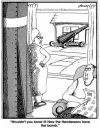
Hendersons_have_the_bomb.webp
 
I tend to agree with the post but offer some clarification as an American gun owner.
3. A general endemic sense of entitlement among gun enthusiasts to own any weapon in existence based on US history of always allowing just that, with few exceptions. I think no one argues that they should be able to own a tank or a howitzer, but many Americans do argue that they should be able to own fully automatic weapons.
Modern semiautomatic gun mechanisms coupled with efficient smokeless propellant render private ownership of fully automatic weapons almost moot. Unnecessary. Even wasteful. With practice and minimal dexterity one can fire as many rounds as necessary while correcting aim in single-fire mode.

More recent military members can correct me but most hand carried GI (government issue) firearms feature a selector switch with safety, single fire, and possibly 3 burst. Fully automatic fire would only be selected in extremis or possibly as cover fire. Movie directors like the sound and fury of fully automatic fire for effect without considering conserving ammunition nor aiming.

Built in sound suppression seems much more useful. Allow enough noise to activate sonic localization devices but otherwise allow manufacturers to suppress loud noise (presuming subsonic ammunition).

Civilian ownership of exotic a/o military grade weapons should be nonstarters. Basic civics tells us there is too much inherent danger to society and no honest requirement.

Likewise, restricting weapons to some arbitrary historical technology lacks merit. Numerous historical societies and gun clubs build, fire and maintain historical "black powder" muzzle loaders and similar old tech. Should computer users be restricted to IBM 360 with dialup modems since computers are used in terrible crimes?

One final comment about bulk ammunition purchases. Ammunition is expensive. Bulk purchases, like buying eggs by the carton, reduce expense. Typical target shooters and training classes expend hundreds of rounds per trip to a range. Buying hundreds of manufactured rounds in bulk is practical not pathological.
 
Civilian ownership of exotic a/o military grade weapons should be nonstarters. Basic civics tells us there is too much inherent danger to society and no honest requirement.

Likewise, restricting weapons to some arbitrary historical technology lacks merit.
I think that you're missing my earlier point. You say that military grade weapons should be non-starters but today's non-military grade weapons were military grade at some point. The scale slid continuously until the invention of the Thomson submachine gun when Congress finally started to realize the dangers of ever more powerful weapons. The main point is that the forefathers didn't imagine the types of weapons that Joe Citizen could own in the future and the horrible damage that could be inflicted upon our own citizens. They were mainly focused on defending themselves from the British army.

The founders put in place the ability to modify the constitution so that the country could change as the times changed - and even undo prior changes like Prohibition. At some point, this country needs to come to the realization that the breadth of the second amendment as it exists today, is no longer in the best interests of society.
 
as many rounds as necessary

restricting weapons to some arbitrary historical technology lacks merit.

Should computer users be restricted to IBM 360 with dialup modems since computers are used in terrible crimes?

I appreciate the response. The above quotes are all related in my mind, so I put them all here together.

The analogy between guns and computers does not work for me. Computers have an uncountable number of use-case categories - its uncountable because human creativity can always come up with more uses.

Firearms have a countable number of use case categories. I argue they are -

1. Self defense
2. Projection of force (the opposite of #1)
3. Hunting
4. Recreational shooting at non-living targets for pleasure and/or competition
5. Simple joy of ownership with no intended use - much like a person who collects watches with no intent to ever wear them

I argue that is it - there are no other use case categories for firearms. If you have any to add, please do, still, I am confident at some point we can arrive at a complete list.

Then, once we have that list, I will ask you to tell me how many rounds are necessary to accomplish each thing on that list. Then, I will say that while restricting weapons arbitrarily lacks merit, restricting weapons based on how many rounds we agree are needed for each thing on the list has merit.

If I get to determine the rules of society, number 2 on the list gets no legal support, and numbers 4 and 5 on the list have to exist within the bounds established by the limits to reasonably accomplish numbers 1 and 3.
 
From what I've heard over the years, these are my impression:
  • Many gun owners support practices like background checks, waiting periods, proper training, etc. Why? Because they recognize the responsibility of gun ownership. It's just like we expect someone driving a car on public roads to have taken driving lessons and passed a driving test and to have liability insurance.
  • The NRA doesn't actually represent gun owners; it represents gun manufacturers. If you recognize that, the NRA's seemingly fanatical opposition to any sort of limit on the sale of firearms makes more sense.
  • People whose lifestyle includes gun ownership—i.e., hunting is regular part of their lives—tend to own a few firearms, and they're not the ones with assault-style weapons.
  • Gun owners where politics is the main motivation are the ones who tend to own the assault-style weapons and tend to own a lot of guns.
  • The interpretation of the 2nd amendment to mean the unfettered right of individuals to own guns is relatively recent.
 
People whose lifestyle includes gun ownership—i.e., hunting is regular part of their lives—tend to own a few firearms, and they're not the ones with assault-style weapons.
This has not been my anecdotal experience. I grew up in the southwest (AZ / NM). If you don't mind saying, what region of the US are you taking those observations from?
 
@Grinkle Here are a few more but may be considered subcategories of the five you listed.

To protect others from crime, like an off-duty policeman. Often pointed out by gun advocates
WRT ammo requirement, it is recommended by self-defense "experts" that a handgun be able to carry at a minimum of 10 rounds.

To remove pests or predators that threaten livestock on farms and ranches.

To manage wildlife populations.

Wannabe "Minute Men". Neighborhood militia.

For hunting or animal control by and large a semiautomatic is not required or useful. Long guns usually carry anywhere between four and seven rounds, but not in a magazine.
 
@gleem Thanks!

I'd rename 'self defense' to 'self defense and/or defense of others' to include this one. I think its the same mindset.

To protect others from crime

I'd call these hunting. One can hunt for reasons other than food.

To remove pests or predators that threaten livestock on farms and ranches.

To manage wildlife populations.

I'd call this projecting force.

Wannabe "Minute Men". Neighborhood militia.
 
This has not been my anecdotal experience. I grew up in the southwest (AZ / NM). If you don't mind saying, what region of the US are you taking those observations from?
I’m not speaking from personal experience. It’s the impressions I’ve gotten from various podcasts and news articles on the gun issues. I could very well be misremembering what I heard or read.
 
I'd be interested in hearing what folks in other countries think about their own firearms regulations.
Honestly, this is not even discussed in Germany. It is a non-issue. But here is what we think about US-American regulations:

Caption: How to smuggle chocolate bars into American movie theaters.

1745935372076.webp
 
People whose lifestyle includes gun ownership—i.e., hunting is regular part of their lives—tend to own a few firearms, and they're not the ones with assault-style weapons.
William English, an assistant professor at Georgetown University School of Business, conducted a demographic study on AR 15 ownership and found it to be quite diverse.


Liberal Democracy Values

  • Free and Fair Elections
  • Rule of Law
  • Separation of Powers & Checks and Balances
  • Protection of Civil Liberties and Human Rights
  • Pluralism & Political Competition
  • Independent Media & Free Press
  • Open Civil Society

Community Values

  • Civility
  • Productivity
  • Good Faith Debate
  • Evidence Based Debate
  • Transparency
  • Integrity

Community Motto

"It is the responsibility of intellectuals to speak the truth and expose lies." - Noam Chomsky
Back
Top